The Story of the Aperol Spritz
Posted on
It’s the glowing orange icon of summer. It’s on every table, in every Instagram feed, and at every aperitivo hour from Milan to Manhattan. But the Aperol Spritz wasn’t born overnight. Its story is a fascinating blend of Austrian occupation, Italian ingenuity, and one of the smartest marketing campaigns in history.
Here is how a bitter-sweet cocktail became a global phenomenon.
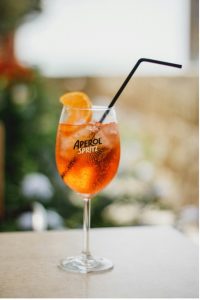
Photo by Kristina Paukshtite on Pexels
Act 1: The Austrian Splash (Early 1800s)
Believe it or not, the story starts not in Italy, but with the Austro-Hungarian Empire. In the early 1800s, Austrian soldiers were stationed in the Veneto region of Northern Italy (home to Venice and Padua) .
They loved the local wine, but found it too strong for their palates. Their solution? They asked for a Spritzen—a German word meaning “a splash”—of water to dilute it . This simple mix of local wine and sparkling water was the very first “Spritz”.
Where to stay: Villa Elena
Photo by Essential Italy©
Act 2: The Birth of Aperol (1919)
Fast forward to 1919. In Padua, two brothers named Luigi and Silvio Barbieri had spent seven years experimenting in their father’s liqueur business. That year, at the Padua International Fair, they unveiled a new aperitivo: Aperol.
It was light, with a low alcohol content (just 11%), bright orange in color, and had a perfectly balanced bittersweet flavour made from a secret recipe of herbs and roots including gentian, rhubarb, and cinchona. It was an instant hit, marketed initially as a light, figure-friendly drink “for women and sporty people”.
Where to stay: Casa Magiona

Photo by Essential Italy©
Act 3: The Perfect Marriage (1950s-1960s)
For decades, Aperol was popular in the North, but it wasn’t yet a cocktail star. The magic happened in the 1950s when someone—likely in the bars of the Venetian Riviera such as Jesolo—had the brilliant idea to combine the Austrian tradition of the “Spritz” with the local bitter, Aperol.
They swapped the still wine for the region’s famous sparkling Prosecco and perfected the now-sacred ratio: 3 parts Prosecco, 2 parts Aperol, and a splash of soda water, served over ice with a slice of orange. The Aperol Spritz was officially born. It became the go-to drink for glamorous socialites from Padua to the French Riviera.
Where to stay: Masseria Apoikia
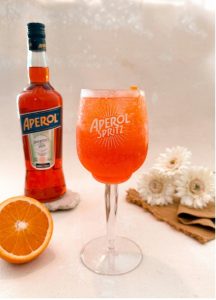
Photo by Victoria Eckell on Pexels
Act 4: The Global Takeover (2000s-Today)
Despite its regional fame, by the early 2000s, Aperol was still relatively unknown outside of Northeastern Italy. That all changed in 2003 when the giant Gruppo Campari bought the brand.
Campari launched a brilliant, long-term marketing campaign to conquer the world. Their strategy? They targeted key bars in trendy neighbourhoods, teaching bartenders how to make the perfect Spritz and even paying stylish people to order it, creating a “cool” effect that others would want to copy .
The timing was perfect. The world was moving toward lower-alcohol, refreshing drinks, and the Aperol Spritz was tailor-made for the age of social media—that bright orange colour was simply made for Instagram. By 2011, it was officially recognized as an IBA (International Bartenders Association) cocktail.
Where to stay: Baglio La Corte
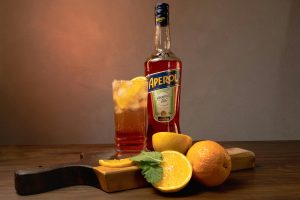
Photo by Vinicius Pittol on Unsplash
The Bottom Line
The Aperol Spritz is more than just a drink. It’s a 200-year journey in a glass: an Austrian custom, a Paduan liqueur, and a Venetian innovation, all turbocharged by 21st-century marketing. It is the taste of la dolce far niente—the sweetness of doing nothing.
So next time you raise your glass of that beautiful orange elixir, you’re not just having a cocktail. You’re toasting to history.
Salute!
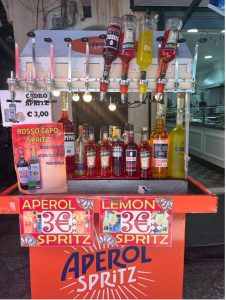
Photo by Essential Italy©